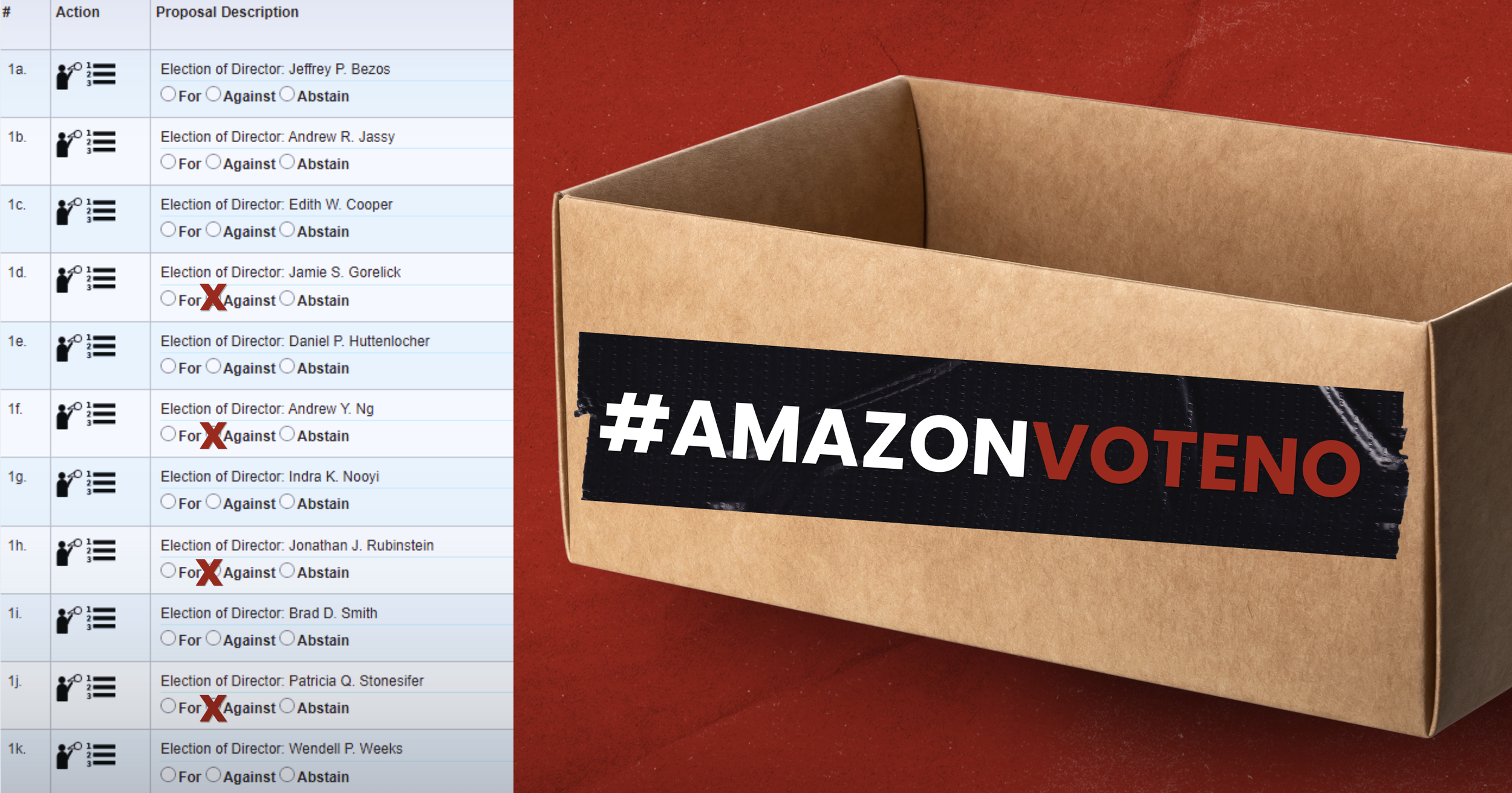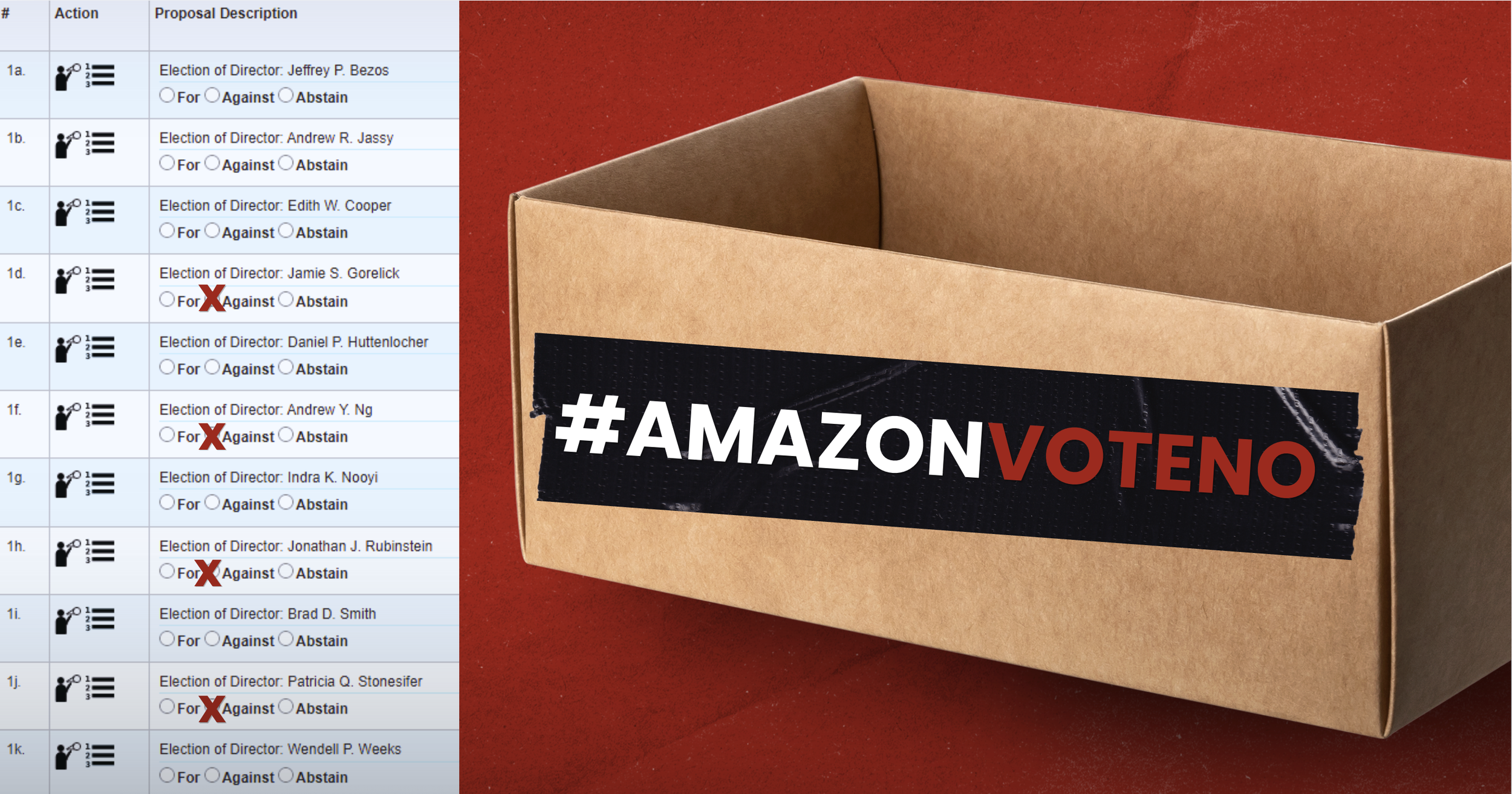
Vote Against Directors Rubinstein, Gorelick, Ng, and Stonesifer
We urge you to vote AGAINST the re-election of Jonathan Rubinstein, Jamie Gorelick, and Andrew Ng, members of the Nominations and Corporate Governance Committee (Nom and Gov Committee), and Patricia Stonesifer, former member of the Nom and Gov Committee, for their decision this year to unilaterally exclude new shareholder proposals filed at Amazon (listed below). We believe the Board has failed to meaningfully engage shareholder proponents, respond constructively to votes, or refresh the committee overseeing its governance practices.
Amazon Has a History of Performative Engagement. We believe that refreshment of the Nom and Gov Committee is long overdue, and would provide the Amazon Board with an opportunity to identify directors who appreciate shareholder engagement and could oversee meaningful changes to Amazon’s governance practices. We urge Amazon investors to vote against Directors Rubinstein, Gorelick, Ng, and Stonesifer.
Latest Insights & Press
Amazon Investors Call For Director Removals Over Proposals (2)
Investors Will Not Be Silenced After Amazon Excludes Responsible AI Proposal

Investors putting US Boards on Notice Over Shareholder Proposal Omissions
Amazon AGM Results Highlight Calls for Board Accountability
Investors Declare Intention to Vote Against Directors Rubinstein, Gorelick, Ng, and Stonesifer

Amazon Pre-Disclosures
New York State Common Retirement Fund - Dominican Sisters of Springfield, IL - Friends Fiduciary Corporation - Northwest Coalition for Responsible Investment - United for Respect Education Fund - NorthStar Asset Management - Maryknoll Sisters - Laura Saunders - AJL Foundation - Ruth Lipscomb - Deborah Sagner - School Sisters of Notre Dame Collective Investment Fund - PFC SpA Società Benefit - Eliana Fishman - Zevin Asset Management - RIFF Foundation - Johanna Gelbspan - Congregation of the Sisters of St. Joseph of Peace - Obran Capital Advisors - Sisters of Charity of Leavenworth - Kate Schwartz - Figure 8 Investment Strategies - Missionary Oblates of Mary Immaculate - Claudia Maria Cellini Argosy Trust - Tess Fruge - Dr. Omer Chaudhary, MPC - Nosheen Ahmad - Omer Chaudhary & Nosheen Ahmad RESP - Omer Chaudhary - Jon Norstog - Mirabaud Asset Management - Storebrand Asset Management - Degroof Petercam Asset Management NV/SA (DPAM)
New York State Common Retirement Fund - Dominican Sisters of Springfield, IL - Friends Fiduciary Corporation - Northwest Coalition for Responsible Investment - United for Respect Education Fund - NorthStar Asset Management - Maryknoll Sisters - Laura Saunders - AJL Foundation - Ruth Lipscomb - Deborah Sagner - School Sisters of Notre Dame Collective Investment Fund - PFC SpA Società Benefit - Eliana Fishman - Zevin Asset Management - RIFF Foundation - Johanna Gelbspan - Congregation of the Sisters of St. Joseph of Peace - Obran Capital Advisors - Sisters of Charity of Leavenworth - Kate Schwartz - Figure 8 Investment Strategies - Missionary Oblates of Mary Immaculate - Claudia Maria Cellini Argosy Trust - Tess Fruge - Dr. Omer Chaudhary, MPC - Nosheen Ahmad - Omer Chaudhary & Nosheen Ahmad RESP - Omer Chaudhary - Jon Norstog - Mirabaud Asset Management - Storebrand Asset Management - Degroof Petercam Asset Management NV/SA (DPAM)
On May 20, 2026, Amazon shareholders cast their votes at the annual general meeting, and the results highlight a strong message: the Company must be held accountable for unilaterally excluding new shareholder proposals, following the SEC’s decision not to weigh in on the majority of “no-action” requests.
In April 2026, shareholder groups (SOC Investment Group, American Baptist Home Mission Societies (ABHMS), United for Respect Education Fund (UFREF), Investor Advocates for Social Justice (IASJ), and Oxfam America) launched a director “vote no” campaign, urging shareholders to vote against directors Rubinstein, Gorelick, Ng, and Stonesifer for being members and former members of Amazon’s Nominations and Corporate Governance Committee – tasked with overseeing corporate governance initiatives. The “vote no” letter called out Amazon for opportunistically excluding shareholder proposals and for not meaningfully engaging with shareholders.
In the midst of hostile attacks on shareholder rights and the corresponding chilling effect, the result is relatively strong.
Jonathan Rubinstein, Chair of the Nominating and Corporate Governance Committee, received only 88.64% support from shareholders when insider shares were excluded. The other members of the committee, Gorelick and Ng, received 91.8% and 93.65%, respectively, and former committee member Stonesifer received 92.53% independent support.
To put this into perspective, it is important to emphasize that director “vote no” initiatives don’t typically result in the selected directors receiving less than the required 50% majority vote. Even lowering the director support by a few percentage points can still be impactful, considering Board nominees usually win the vast majority of shareholder votes. For example, in 2025, the average support for Board nominees was between 95.4% and 96.6%. In its 2026 guide, PwC considers a vote result in the 60s or 70s to be a strong result. Given the increasingly challenging environment in which responsible investors operate, we believe that 11.36% opposition to Chair Rubinstein from independent shareholders sends a clear message to Amazon: investors are dissatisfied with the company’s taking advantage of new SEC rules and lack of meaningful engagement with shareholders.
Who supported?
Despite lack of support for the “vote no” campaign from large proxy advisors ISS and Glass Lewis, and other influential actors (CalPERS, CalSTRS, and Norges Bank), there were many who pre-disclosed their intention to vote against the four directors who were subject to the “vote no.” These included:
The director “vote no” results come at a time of intense attacks on shareholder rights and increased scrutiny of anything associated with ESG. The growing list of the SEC’s undermining of shareholder rights is concerning: making it easier to exclude proposals through the “micromanagement” exclusion; deciding to no longer weigh in on the majority of company “no-action” requests; removing the option for shareholders with less than $5 million in a company’s shares to file on the SEC’s EDGAR system; etc. In December 2025, President Trump issued Executive Order 14366, targeted at proxy advisors ISS and Glass Lewis, which described the firms as advancing “radical politically-motivated agendas. Recently, a group of four Attorneys General sued ISS for incorporating ESG factors into its recommendations. This came after the Florida Attorney General sued both ISS and Glass Lewis in November 2025 for “inject[ing] controversial environmental, social, and governance (ESG) demands into nearly every voting recommendation they delivered, pressuring companies to adopt race- and gender-based quota policies, ideological climate mandates, and other directives that expose businesses to legal and financial risk.”
The cumulative impact of the coordinated efforts to undermine shareholder rights has created a chilling effect, with support of ESG proposals continually declining, particularly by US-based institutional investors.
In Pope Leo XIV’s landmark AI encyclical, Magnifica Humanitas, released publicly on May 25, he addressed AI developers directly. “I wish to address a special appeal to those who develop artificial intelligence. In one sense, technological innovation can represent human participation in the divine act of creation. Developers, therefore, bear a particular ethical and spiritual responsibility, for every design choice reflects a vision of humanity. Just as the creator of an artistic or literary work must consider the values it conveys, so developers are called to embed values in their projects with due seriousness: with transparency, responsibility toward affected communities, and careful attention to ensuring that what is being cultivated is a genuine good.”
Pope Leo XIV’s warnings are central to our collective shareholder advocacy efforts, underscoring the urgency of investor engagement and the continued need for advocacy. Shareholders have ownership rights in the companies they have shares in and the right to transparency about how those companies operate. Investors must continue to collaborate and push back on the systematic attempt to dismantle what took decades to build.
Amazon AGM Results Highlight Calls for Board Accountability
June 1, 2026
Investors Declare Intention to Vote AGAINST directors Rubinstein, Gorelick, Ng, and Stonesifer
May 13, 2026
A group of investors has publicly disclosed plans to vote AGAINST Amazon Directors Jonathan Rubinstein, Jamie Gorelick, Andrew Ng, and Patricia Stonesifer ahead of the company’s upcoming AGM. The vote pre-disclosure is part of a broader Director “Vote No” campaign led by SOC Investment Group, American Baptist Home Mission Societies (ABHMS), United for Respect Education Fund (UFREF), Investor Advocates for Social Justice (IASJ), and Oxfam America in response to Amazon’s decision to unilaterally exclude shareholder proposals from this year’s proxy statement.
Intention to Vote AGAINST directors Rubinstein, Gorelick, Ng, and Stonesifer
We, the undersigned Amazon.com Inc. (“Amazon”) investors representing approximately $7,057,750,048.89 in assets under management or advisement and $70,235,554.66 in Amazon company stock, are announcing our intention to vote AGAINST Amazon directors Jonathan Rubinstein, Jamie Gorelick, Andrew Ng, and Patricia Stonesifer, current and former members of the Board’s Nominations and Corporate Governance Committee, which is charged with “[overseeing] the Company’s corporate governance initiatives”.
We are voting against these four directors for the company’s decision this year to unilaterally exclude three new shareholder proposals, including a shareholder proposal on alignment between Amazon’s sale and deployment of AI and related technologies with its Responsible AI Approach. In particular, this proposal was filed by over 30 shareholders and highlighted serious concerns about “rights-violating applications of [Amazon’s] AI and related technologies,” including:
Amazon’s $1.2 billion cloud computing contract with Israel – Project Nimbus – which has been used by Israel in its attacks on Palestinians, actions prominent human rights organizations have classified as genocide; and
Amazon’s AI and related technologies, enabling the US’ expansive immigration crackdown, in which US Department of Homeland Security agencies have been accused of arbitrary detentions, silencing free speech, and violating rights to privacy, nondiscrimination, asylum protections, due process, and other human rights.
We believe Amazon has opportunistically taken advantage of the SEC’s November decision to no longer weigh in on the majority of company “no action” requests by unilaterally excluding this and other shareholder proposals that should have been brought to a vote before the companies’ shareholders. Moreover, we believe the Board has failed to meaningfully engage shareholder proponents, respond constructively to votes, or refresh the committee overseeing its governance practices.
Therefore, we are voting against directors Rubinstein, Gorelick, Ng, and Stonesifer because we believe that refreshment of the Nominations and Corporate Governance Committee is long overdue, and would provide the Amazon Board with an opportunity to identify directors who appreciate meaningful shareholder engagement and could oversee meaningful changes to Amazon’s governance practices.
Sincerely,
Dominican Sisters of Springfield, IL
Friends Fiduciary Corporation
Northwest Coalition for Responsible Investment
United for Respect Education Fund
NorthStar Asset Management
Maryknoll Sisters
Laura Saunders
AJL Foundation
Ruth Lipscomb
Deborah Sagner
School Sisters of Notre Dame Collective Investment Fund
PFC SpA Società Benefit
Eliana Fishman
Zevin Asset Management
RIFF Foundation
Johanna Gelbspan
Congregation of the Sisters of St. Joseph of Peace
Obran Capital Advisors
Sisters of Charity of Leavenworth
Kate Schwartz
Figure 8 Investment Strategies
Missionary Oblates of Mary Immaculate
Claudia Maria Cellini Argosy Trust
Tess Fruge
Dr. Omer Chaudhary, MPC
Nosheen Ahmad
Omer Chaudhary & Nosheen Ahmad RESP
Omer Chaudhary
Jon Norstog
Investors Will Not Be Silenced After Amazon Excludes Responsible AI Human Rights Proposal
May 7, 2026
On April 20, 2026, SOC Investment Group, American Baptist Home Mission Societies (ABHMS), Investor Advocates for Social Justice (IASJ), Oxfam America, and United for Respect Education Fund (UFREF) launched a director “Vote No” campaign at Amazon, citing governance failures, opportunistic taking advantage of the SEC’s new guidance on excluding shareholder proposals, and a pattern of a lack of meaningful engagement with shareholders. A director “Vote No” campaign is an escalation tool used by investors seeking changes in oversight and governance at public companies. By asking shareholders to vote against particular members of the board, the “Vote No” campaign is intended to put pressure on the board and could help effect positive change.
Last year, ABHMS, represented by IASJ, and over 30 co-filers, including UFREF, filed a shareholder proposal that raised concerns about the human rights risks associated with the company’s AI and cloud computing services (Responsible AI proposal). Amazon excluded the shareholder proposal, following a November 2025 update from the US Securities and Exchange Commission (SEC), which announced it would no longer weigh in on the no-action process under Rule 14a-8. This change effectively allows companies to unilaterally exclude shareholder proposals without SEC review or oversight. While companies are not required to take advantage of this regulatory change, Amazon chose to do so, preventing shareholders from voting on a proposal addressing material governance, legal, and human rights risks. Many peer companies have continued to engage constructively with investors despite the regulatory shift. Instead, Amazon’s decision limited opportunities for investor dialogue and oversight on issues that shareholders have repeatedly raised over multiple years.
“For years, we have raised concerns about the misuse of Amazon’s technologies and the serious human rights risks that may result. After Amazon chose to exclude our shareholder proposal on responsible AI, denying investors the opportunity to vote, we chose to co-lead a “Vote No” campaign to ensure these concerns are still formally raised before the company and its shareholders. Shareholders have a right to demand transparency and accountability. Excluding a shareholder proposal does not eliminate the underlying issues, and we believe Amazon must respond to concerns about how its technologies may be contributing to human rights harms in the United States and globally,” stated Gina Haas, Director of Investment, American Baptist Home Mission Societies, the lead filer.
Investors have attempted to engage the company on these issues for several years without meaningful or sustained responses. Amazon has repeatedly declined to engage in dialogue with investors, even after a related proposal addressing customer due diligence and similar human rights concerns received over 41% support. This pattern of limited transparency and responsiveness, amidst growing concerns, underscores why shareholders have brought forward this proposal.
Following Amazon’s unilateral decision to exclude the Responsible AI proposal, the Proponent requested meaningful dialogue with the company to discuss the underlying concerns. Amazon offered to meet with the Proponent, but said it would be “impossible” to discuss the underlying issues, and it would only attend in “listen-only” mode. The Proponent believes Amazon’s proposed meeting would neither be meaningful nor dialogue and responded that it was “unable to accept [Amazon’s] offer unless and until there is an opportunity for meaningful and constructive dialogue between Amazon and shareholders.”
In response to Amazon’s exclusion of the shareholder proposal (as well as two other highlighted shareholder proposals that were also excluded), the five groups launched the Vote No campaign, urging shareholders to vote against the re-election of Jonathan Rubinstein, Jamie Gorelick, Andrew Ng, and Patricia Stonesifer.
Additionally, UFREF Co-Executive Director, Bianca Agustin, filed a floor proposal calling on Amazon to create an independent Artificial Intelligence and Automation Advisory Council to address AI development and deployment, particularly as they relate to Amazon workers’ rights. Due to procedural limitations, floor proposals are generally unlikely to garner substantial support. Despite this, the move reflects an alternative approach to addressing shareholder concerns.
Joan, an Amazon Warehouse Associate for 4+ years, said, “Being silent means that we are complicit in AI taking our jobs. Anger means nothing unless we channel it into worker power. Amazon may be customer-driven, but its workers are the backbone that keeps the company afloat, ensuring they receive their merchandise.”
Issues Raised in the Proposals:
Project Nimbus and Heightened Human Rights Concerns in Gaza
Over the years, investors have raised concerns about Amazon Web Services (AWS) regarding misalignment between Amazon’s Responsible AI commitments and real-world deployments. Under the $1.2 billion Project Nimbus contract between AWS and the Israeli government, AWS provides cloud infrastructure and AI-enabled capabilities used across governmental and military operations in Gaza. These operations have drawn condemnation from international human rights organizations and UN mandate holders, several of whom have warned of the potential commission of international crimes.
Investigations in 2024 documented Israeli military units’ use of AWS infrastructure to store, process, and analyze extensive surveillance and operational data and, in some instances, to support targeting workflows associated with airstrikes that resulted in civilian casualties. A subsequent 2025 investigation reported that Project Nimbus’ contractual terms prohibit AWS from suspending or limiting service, even in cases of possible misuse, and require the Company to violate court-ordered gag orders. These provisions raise significant legal, policy, and reputational risks for Amazon, particularly given the elevated scrutiny of technology companies’ involvement in conflict settings
UN Special Rapporteur Report Highlights Amazon’s Role in Human Rights Violations in Gaza
A recent report by the UN Special Rapporteur on the occupied Palestinian territories highlighted how major cloud and technology providers like Amazon can contribute to what the report termed an “economy of genocide,” identifying Project Nimbus as a key component enabling data processing, surveillance, and military decision-making capabilities in Gaza. In public statements, Israeli officials have described cloud and AI tools as operational assets in conflict, intensifying scrutiny of technology companies’ responsibilities in high-risk environments.
Human Rights Risks in US Immigration Surveillance and Enforcement
Investors also highlight misalignment risks in Amazon’s provision of AI and cloud services to US immigration authorities. AWS hosts critical Department of Homeland Security (DHS) systems used in immigration enforcement, including data-analytic tools that support monitoring, detention, and deportation operations. AWS infrastructure is also expected to underpin DHS’s forthcoming HART biometric and analytical system, a large-scale AI-driven platform that civil rights organizations warn may amplify discriminatory surveillance practices, undermine due process concerns, and enable invasive data collection.
Maria Diaz, Make the Road member, stated, “My son, who has lived in this country for more than a decade, worked here and built a family and full life here, was abducted and detained by masked ICE officers last month. Our family has been shattered, and we are not sure if we will ever see him again. Amazon is complicit in the separation of hundreds of thousands of families like mine. Amazon profits from the pain of mothers that fear they will never see their sons again. I call on Amazon to cut their ties with ICE and for an immediate investigation into Amazon’s role in the Trump administration’s attacks on immigrants and citizens alike.” These risks raise questions about whether current oversight mechanisms are adequate to ensure consistency with Amazon’s Responsible AI Approach.
Ring Cameras and Immigration Enforcement Concerns
Amazon’s broadening portfolio of consumer surveillance technologies has further intensified investor concern. Ring, Amazon’s home-security subsidiary, has recently introduced facial-recognition features and expanded its partnerships with local law-enforcement agencies. Ring also announced an integration with Flock Safety, whose automated license plate and vehicle-tracking data has been accessed by immigration authorities. These developments heighten the risk that Amazon’s AI-driven products may enable discriminatory policing, exacerbate civil rights harms, or be deployed in ways inconsistent with the Company’s stated commitments. The Company recently canceled this planned partnership with Flock Safety following significant public and stakeholder backlash over surveillance concerns.
Growing Investor Concern
Recent investor action demonstrates that these concerns are no longer isolated. A comparable shareholder proposal at Microsoft received more than 25% of shareholder support and a recommendation from Institutional Shareholder Services (ISS), signaling substantial investor concern that inadequate governance of AI systems and cloud services may contribute to serious human rights harms. This level of support reflects a broader shift in investor expectations.
Importantly, investors are now differentiating between companies based on how they respond to these risks. Microsoft had engaged with investors for several years on responsible technology use prior to the filing and took concrete steps when concerns intensified. In September 2025, Microsoft terminated specific cloud and AI services provided to the Israeli military’s intelligence Unit 8200 following investigations and public reporting that the technology had been used for mass surveillance of Palestinians in ways that raised serious questions about compliance with the company’s Responsible AI commitments and human rights policies. The decision followed sustained investor engagement, media scrutiny, and public pressure, illustrating how companies can respond substantively to emerging risks.
However, reporting by The Guardian and intelligence sources indicates that the termination did not halt the surveillance activities. Instead, in early August 2025, Unit 8200 reportedly transferred approximately 8,000 terabytes of intercepted communications data from Microsoft’s cloud infrastructure to AWS, as part of a broader migration toward providers participating in the Israeli government’s Project Nimbus contracts, including Amazon and Google. As of late September 2025, Amazon had not publicly responded to inquiries regarding the reported transfer of surveillance data to its platform.
In contrast to Microsoft’s actions, Amazon has not conducted a comparable independent review, meaningfully engaged with shareholders in sustained dialogue on these concerns, or provided sufficient transparency regarding how it assesses and manages high-risk uses of its technologies, despite sustained pressure from investors, civil society, and its own workers. There is a widening gap among companies, and investors are disappointed and incredibly concerned by Amazon’s lack of transparency and responsiveness to its own shareholders.
Amazon Warehouse Workers Demand Oversight with an Independent AI and Automation Advisory Council in Response to Counter Robot Bosses
Amazon Associates experience the consequences of Amazon’s rapid deployment of advanced technologies on a daily basis. From algorithmic management to AI-driven surveillance and robotics, these systems function as “robot bosses,” dictating some of the most granular aspects of an Associate’s tasks, including how they walk through the warehouse or bend over to move a package. These opaque technology systems also administer punitive disciplinary actions through an unaccountable robot boss.
Amazon claims that deploying advanced technologies makes workers safer. But injury rates in Amazon warehouses remain high, exposing workers and investors to material risks across the company’s warehouse and logistics operations. Jason Carletti, Amazon Warehouse Associate, shared, “As for safety, I don’t really see changes because of AI yet. But I do think it’s coming. I can see a future where AI is used to determine what is safe and unsafe and dictate what workers can and can’t do. Do I see it helping associates? No. I think it’s more likely to make jobs harder and less efficient.”
The floor proposal seeks to create an independent Artificial Intelligence and Automation Advisory Council that would provide oversight and recommendations regarding the development and deployment of these technologies. This council would include hourly warehouse associates and frontline workers, alongside independent experts in civil rights, labor standards, occupational safety, and technology ethics.
Conclusion
Shareholders will continue to pursue all available avenues to ensure that material human rights, governance, and risk concerns are addressed transparently and responsibly. As investor expectations across the technology sector continue to rise, companies that fail to engage meaningfully or implement robust oversight risk falling behind both their peers and the evolving standards of responsible corporate governance, and leave themselves susceptible to being connected to major human rights violations.
Despite the SEC’s weakening of shareholder rights, Amazon’s unilateral exclusion of the Responsible AI proposal and other shareholder proposals, and the company’s lack of meaningful engagement with shareholders, responsible investors will not be silenced. The “Vote No” campaign and the floor proposal highlight the resilience and creativity of a cross-section of shareholders who stand up for human rights and call for transparency and accountability at Amazon.
For more information, please contact: Aaron Acosta aacosta@iasj.org and UFR: press@united4respect.org
Vote Against Directors Rubinstein, Gorelick, Ng, and Stonesifer
April 20, 2026
We urge you to vote AGAINST the re-election of Jonathan Rubinstein, Jamie Gorelick, and Andrew Ng, members of the Nominations and Corporate Governance Committee (Nom and Gov Committee), and Patricia Stonesifer, former member of the Nom and Gov Committee, for their decision this year to unilaterally exclude new shareholder proposals filed at Amazon (listed below). We believe the Board has failed to meaningfully engage shareholder proponents, respond constructively to votes, or refresh the committee overseeing its governance practices.
Amazon Has a History of Performative Engagement. We believe that refreshment of the Nom and Gov Committee is long overdue, and would provide the Amazon Board with an opportunity to identify directors who appreciate shareholder engagement and could oversee meaningful changes to Amazon’s governance practices. We urge Amazon investors to vote against Directors Rubinstein, Gorelick, Ng, and Stonesifer.
The shareholder proposals, which are the subject of this “Vote No” action, focused on US immigration policy risks, responsible AI alignment, and human rights reporting. The full text of these proposals can be found here.
Disclaimer
* The written materials on this site are shared pursuant to an exemption provided for in Rule 14a-2(b)(1) promulgated under the Securities Exchange Act of 1934.
Other Ways to Get Involved
Vote FOR Proposals #5 and #7
Proposals #5
Proposal # 5, filed by As You Sow and Mercy Investment Services, Inc., requests additional reporting on the impact of data centers on climate commitments.
Proposals # 7
Proposal # 7, filed by the AFL-CIO, requests a mandatory independent board chair policy.
Vote FOR a Floor Resolution, filed by United For Respect Education Fund's, Co-Executive Director, Bianca Agustin, requesting Amazon establish and maintain an independent Artificial Intelligence and Automation Advisory Council.
The floor resolution does not appear on Amazon’s 2026 proxy statement, and shareholders can only vote on this item during the AGM on May 20, 2026.